
Basketball at the 1904 Summer Olympics
Basketball debuted as a demonstration sport at the 1904 Olympics.

Wikipedia / Wikimedia Commons
Basketball made its debut at the 1904 Summer Olympics in St. Louis as a demonstration sport. The program included seven separate competitions: one amateur championship, one college championship, one YMCA championship, two high school championships, and two elementary school championships.
In the men's amateur championship, the Buffalo German YMCA dominated the competition. Many other teams frequently failed to field a full squad or failed to appear for scheduled games, leading to numerous forfeits and lopsided scores.
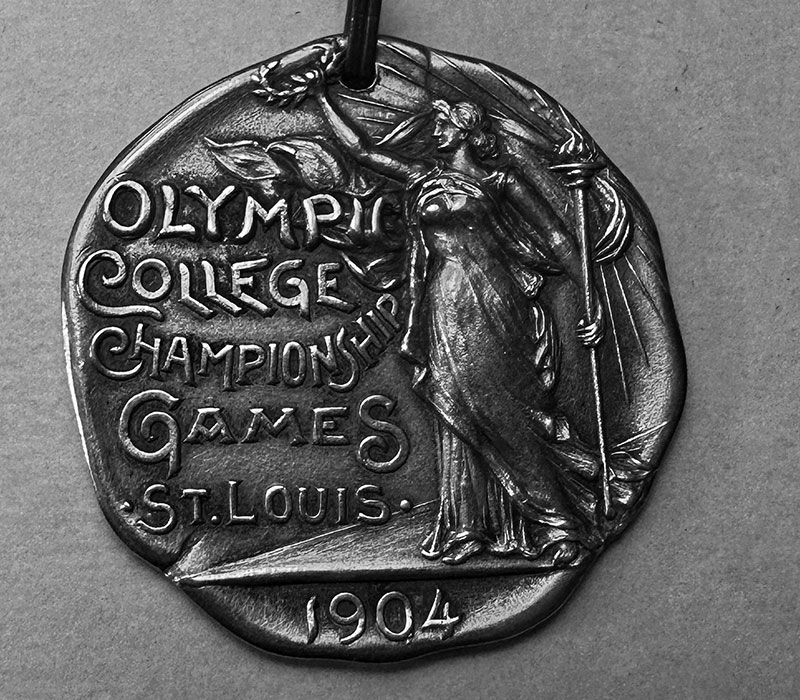
The college basketball tournament featured three teams. Hiram College defeated Wheaton College 23–20 and Latter-day Saints' University 25–18. Wheaton College beat Latter-day Saints' University 40–35. Hiram finished with a 2–0 record, Wheaton went 1–1, and Latter-day Saints' University finished 0–2.
In women's basketball, the Fort Shaw Indian School Girls Basketball Team faced the Missouri All-Stars, alumnae of Central High in St. Louis. Fort Shaw won the first game 24–2. The St. Louis team failed to appear for the second game and forfeited, but asked to continue the competition, and Fort Shaw agreed. The second game ended 17–6, giving Fort Shaw the title as basketball champions of the 1904 St. Louis World's Fair. On August 25, the team won the silver and gold cup for women's basketball at the fair. Although they were entered only in the women's bracket, they also won the general competition—a result that was conveniently omitted from Spalding's Athletic Almanac. The story of the Fort Shaw team is told in the book *Full Court Quest*.
- first_appearance
- 1904 Summer Olympics, St. Louis
- status
- Demonstration sport
- events
- 7 (amateur, college, YMCA, two high school, two elementary)
- college_champion
- Hiram College (2–0)
- women's_champion
- Fort Shaw Indian School Girls Basketball Team
Lore & Background
The Buffalo German YMCA dominated the men's amateur championship while other teams frequently failed to field a complete team or show up for all their scheduled games, resulting in several lopsided scores and forfeited matches. In the college basketball event, Hiram College defeated Wheaton College 23–20 and Latter-day Saints' University 25–18, while Wheaton beat Latter-day Saints' University 40–35, giving Hiram a 2–0 record, Wheaton 1–1, and Latter-day Saints' University 0–2.
Reader's Guide
The 1904 Summer Olympics marked the first appearance of basketball as a demonstration sport, held in St. Louis. The event featured seven separate competitions across amateur, college, YMCA, high school, and elementary school levels. The Buffalo German YMCA dominated the men's amateur championship, though many teams failed to field complete squads or show for games, leading to forfeits and lopsided scores. In the college bracket, Hiram College went undefeated. The Fort Shaw Indian School Girls Basketball Team won the women's title, defeating the Missouri All-Stars 24–2 and then winning a second game 17–6 after the St. Louis team forfeited but asked to continue. Fort Shaw won the silver and gold cup for women's basketball on August 25. Despite being signed up only for the women's bracket, they won in the general competition, a fact omitted from Spalding's Athletic Almanac. Their story is told in the book Full Court Quest.
Did You Know?
- Basketball appeared at the 1904 Summer Olympics in St. Louis for the first time as a demonstration sport.
- The Buffalo German YMCA dominated the men's amateur championship while other teams frequently failed to field a complete team or show up for all their scheduled games.
- The Fort Shaw Indian School Girls Basketball Team won the women's title and also won in the general competition, something omitted from Spalding's Athletic Almanac.
- The Fort Shaw team story is told in a book entitled Full Court Quest.
The Unusual Path to Hosting
The road to hosting the 2028 Summer Olympics was anything but straightforward. When the IOC opened the candidature process in September 2015, five cities—Budapest, Hamburg, Los Angeles, Paris, and Rome—entered the race for the 2024 Games. Three of those candidates eventually pulled out, leaving just Los Angeles and Paris standing. This echoed a similar collapse seen during the 2022 Winter Olympics bidding, where multiple withdrawals narrowed the field to just two contenders. In April 2017, Olympic officials met with both remaining bid committees in Denmark to explore naming two winners simultaneously. By June 2017, the IOC executive board in Lausanne discussed awarding both 2024 and 2028 at once, a proposal approved at an Extraordinary Session on July 11. Paris, whose 2024 Games would mark the centennial of its 1924 Olympics, was naturally preferred for the earlier slot. On July 31, Los Angeles was declared the sole candidate for 2028, backed by $1.8 billion in additional IOC funding. The City Council voted unanimously in August, and on September 13, 2017, a unanimous IOC vote in Lima, Peru, formally awarded the Games to Los Angeles.
A City's Infrastructure Gamble
Los Angeles initially envisioned a car-free Olympic experience, a bold pledge to reduce congestion and ease security logistics around venues. Former Mayor Eric Garcetti launched the Twenty-eight by '28 initiative, targeting 28 infrastructure projects for completion before the Games, funded through countywide sales tax measures like Measure R and Measure M. Mayor Karen Bass later added strategies such as encouraging remote work during the event to ease pressure on transit networks. However, by March 2024, the original list had been substantially revised—eleven projects, including five rail line expansions, were swapped for smaller, more achievable ones. Concerns mounted by late 2024 that only 5.2% of LA Metro's $3.3 billion Olympic-related project list was actually funded, with several initiatives running behind schedule. Compounding these difficulties were staffing uncertainties at government agencies, coordination challenges between agencies, and the late finalization of the Olympic venue list. Faced with these realities, civic leaders shifted their language from an ambitious car-free promise to a more pragmatic transit-first approach.
Historic Milestones and Precedents
The 2028 Games carry a weight of historical firsts that set them apart from any other Summer Olympics. Los Angeles will become the third city in Olympic history to host the Summer Games three times, joining London (1908, 1948, 2012) and Paris (1900, 1924, 2024). Crucially, it will be the first non-European city to achieve this distinction, having previously hosted in 1932 and 1984. For the United States, these Games represent the fifth Summer Olympics and the ninth Olympic Games overall held on American soil. They will also be the first Summer Olympics conducted under the IOC presidency of Kirsty Coventry, marking a new era of leadership for the organization. The Games will span July 14 to 30, 2028, with events distributed across the Greater Los Angeles area and two additional subsites in Oklahoma City. IOC president Thomas Bach specifically praised the bid's reliance on existing and temporary facilities and its use of entirely private funding, a model that distinguished it from many previous Olympic bids.
Evolving the Olympic Program
The 2028 program reflects a significant evolution in the Olympic sport lineup. Three sports—skateboarding, sport climbing, and surfing—that debuted as optional events in 2020 will be elevated to the core program, signaling their permanent place in the Olympic family. Beyond these promotions, the Games will introduce flag football and squash as new optional sports, expanding the roster of disciplines on display. Perhaps most notably, several sports will make long-awaited returns: baseball and softball will reappear, cricket will compete for the first time since 1900, and lacrosse will return as a medal event for the first time since 1908. This blend of new additions, elevated existing sports, and historical revivals creates a program that simultaneously honors Olympic tradition and embraces modern athletic culture. The result is a Games lineup that speaks to a deliberately broadened vision of what Olympic sport can encompass, drawing from both contemporary youth culture and the earliest decades of the modern Olympic movement.
Gallery
More in Basketball at the Summer Olympics 1-24
Spotted an error? Know more?
This is a living reference — every entry is fact-audited, and reader corrections feed straight into our audit queue. Suggest an edit · See this site's audit record